


Framework opening — what this structure does
This framework lays out the minimal, rigorous tests a pergola business must run to guarantee safe, durable products and consistent installations; it organises priorities rather than prescribing every procedure. Firms that add renewable elements will need a different emphasis — integrating a solar pergola changes electrical and sealing tests from optional to compulsory. The approach below ranks tests by risk and by impact on long-term performance, so you can allocate laboratory time and on-site checks where they matter most.
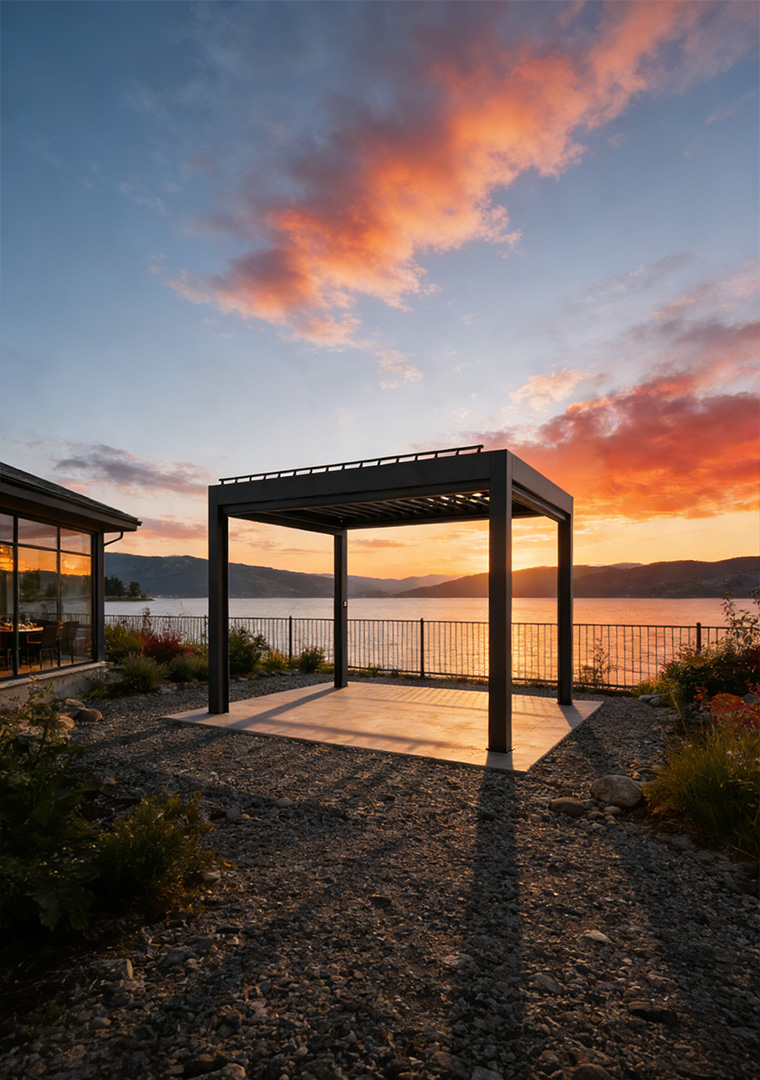
Principles of the quality-control framework
Begin with clear acceptance criteria, then map tests to those criteria. Tests must answer three questions: does the product meet regulatory loads, will components last in the intended environment, and can the system be installed and serviced reliably. Use pass/fail thresholds that reflect field reality; a nominal value from paperwork alone will not suffice. Keep sampling statistically defensible and document every non-conformance so corrective action is traceable.
Core tests to include
Load and stability testing for structural elements, cyclic fatigue for moving louvers, water penetration and drainage verification, corrosion resistance for metallic finishes, motor and control endurance tests, electrical insulation and earthing checks where power is present, and finish abrasion and UV exposure tests. If glazing or polycarbonate is part of the system, include impact and weathering tests. For any roof-mounted kit, verify wind uplift performance to the appropriate design pressure.

Testing methods and pass criteria
Use standardised methods where available: static and dynamic load rigs for structural members, salt-spray chambers for corrosion, thermal cycling for sealants, and motor-run cycles to simulate years of operation. Define acceptance as measurable criteria — deflection limits, cycles to functional failure, allowable leakage rate — and require third-party validation for any claims that materially affect safety or warranty. Record test setup, instrumentation, raw data and post-test inspections so results are reproducible.
Experience, evidence and standards
Practical experience and recognised standards must guide test choices. Drawing on two decades of façade and outdoor-living product work shows why industry norms matter: wind and solar retrofits behave very differently in high-sun, low-humidity regions than in marine climates. Southern California installations commonly reveal aluminium corrosion and drainage problems sooner than expected, so manufacturers serving such markets should stress corrosion, drainage and UV testing; this is especially true for outdoor louvered pergola systems. Refer to established standards (structural design codes like ASCE/SEI 7 or EN 1991 for wind loads, material standards and ISO test methods for corrosion and weathering) and use accredited test houses for verification to build real trust with customers.
Common pitfalls and mistakes
Sampling too few units, neglecting interfaces (fasteners, sealants, gaskets), relying solely on component certificates rather than system tests, and skipping long-duration endurance runs are the most frequent failures. Avoid lab-only validation that ignores installation variation; poor on-site fastening or incorrect sealing often defeats otherwise robust laboratory performance. Training installers and auditing field installations must be part of quality control.
Inspection, documentation and traceability
Inspection protocols should link batch numbers to test results and to as-built site records. Preserve photographic evidence, instrument logs and calibration certificates. Maintain a non-conformance database with root-cause analysis and corrective action timelines. Supplier audits are non-negotiable: raw-material variations and process drift at tier suppliers are common sources of failure.
Putting the framework into practice
Prioritise tests by safety impact and service-life cost. Run a baseline suite at product launch, and then adopt a sampling schedule for production validated by statistical confidence levels. Combine accredited laboratory work with periodic field trials and installer audits so tests reflect real conditions. The result is a coherent, actionable programme that protects end-users and clarifies warranty exposure; it is the sort of practical assurance that a business relying on well-documented, tested systems naturally expects from Light Hunter.
