


A buyer worksheet for Ptc Air Heater: questions raised by RFQ preparation for early research
An RFQ is most useful when it turns an early product search into a defined technical question. For a ptc air heater, operations teams should record the intended equipment, available electrical supply, mounting space, and expected connection method before comparing responses. The goal is not to select a heater from a short description. It is to give suppliers enough structured information to identify a relevant configuration while keeping unconfirmed assumptions visible.

Define the use case and constraints
Begin with the equipment that needs heat and the part of the system where the heater will sit. The captured product page lists applications including egg incubators, 3D printers, HVAC, medical and laboratory equipment, industrial machinery, and electrical cabinets. That list can help an operations team describe the application category in an RFQ, but it does not establish that every listed configuration suits every application.
Describe the available supply as a fixed requirement, not as a preference. The page’s technical table lists examples at 12V, 24V, 48V, 110V, and 220V, with listed power values from 50W to 200W for the displayed product options. These entries are product-specific evidence. They should be copied into the worksheet as candidate values rather than treated as a complete range for every PTC heater.
Space and installation details also belong in the first draft. Record the available envelope, airflow path, mounting direction, nearby materials, and access for wiring. If the application needs a compact assembly, state that requirement separately from the product name. This avoids allowing a familiar category label to stand in for an actual dimensional or integration requirement.
Map stated evidence to requirements
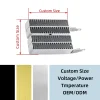
A simple worksheet can divide each requirement into three columns: required, shown on the page, and still open. Voltage and power can be mapped to the listed product table. The page identifies all displayed options as 2-row heaters and includes product names with a 92 × 31 × 25 mm format, so those details can be recorded against the candidate configuration shown there. Do not transfer them automatically to another model.
Termination is another practical RFQ field. The page states that standard options include lead wires, solder tabs, and screw terminals. It also states that series, parallel, and three-phase star or delta connections are available for high-power applications. Ask the supplier to match the proposed termination to the equipment interface, rather than assuming that a listed option is included in every configuration.
Material and protection questions should be stated plainly. The official page describes a conductive type as a conductive surface with lower cost and higher power density, and it says that proper housing and insulation protection are required. This is the selected real-world anchor for the comparison: it connects the variation keyword, ptc air heater factory, to a specific application consideration on the official page. It does not establish performance or suitability beyond that stated product and application scope.
Turn open points into supplier questions
Once the evidence is separated from the requirements, convert every open point into a question that can receive a direct answer. Ask which displayed voltage and power combination corresponds to the intended supply. Ask whether the 2-row construction and listed dimensions apply to the proposed configuration. Ask which termination is recommended for the existing harness or terminal block.
For a conductive design, ask the supplier to define the required housing and insulation arrangement for the intended installation. Keep that question tied to the actual enclosure and airflow layout. The page supports the need for proper housing and insulation protection, but it does not provide a general safety rating, a temperature limit, an airflow result, or a compatibility guarantee. Those unsupported conclusions should not be filled in during early research.
Use the application description to make the RFQ concrete. For example, an electrical cabinet request should identify the cabinet space, supply, mounting arrangement, and control interface. An incubator request should identify the enclosure and control setup. The page includes an egg incubator with open doors, stacked egg trays, and a digital control panel as an application image description, but that description alone does not define the heater’s performance in an incubator.
The supplier’s response should preserve the same structure as the request. Ask for the proposed product name, voltage, power, row count, dimensions, termination, and any application-specific housing requirements. A response that answers each field is easier to compare than a general statement that a heater can be customized.
Summarize a defensible next step
At the end of early research, produce a one-page sourcing brief. Put the operating use and available space first. Follow with the required supply, target power, mounting and connection details, and the evidence that supports each field. Add a separate section titled “open points” for information that the captured page does not settle.
That brief can then support a focused supplier exchange instead of a broad request for a “suitable” heater. The official page states that its engineering team can provide a solution when requirements are supplied. A useful RFQ therefore gives the team a defined input: application, constraints, candidate configuration, and questions requiring confirmation.
- Record the application category, including HVAC, electrical cabinets, industrial machinery, or other listed uses.
- Match the required supply and power to the displayed product-specific voltage and wattage entries.
- Specify the required termination, using lead wires, solder tabs, or screw terminals as the stated options.
- For a conductive type, include housing and insulation protection as an open installation requirement.
For operations teams, the defensible next step is not to claim that one heater is ready for release. It is to document the use case, match only the specifications shown for the relevant product, and send the remaining interface and protection questions to PTCYIDU with the RFQ. That record keeps early research practical while preventing page-listed details from becoming unsupported assumptions.
